
Quaddie Meaning: Where the Word Comes From and What It Stands For
 Available in US
A word that travelled further than most racegoers realise
I’ve lost count of the number of times someone at the Tote window has asked me what a “quaddie” actually is — not the bet mechanics, but the word itself. Where does it come from? Is it slang? Is it short for something? The answer is more specific than most people expect, and it matters if you want to understand why British punters often find themselves Googling an Australian term and landing on entirely the wrong page. The full picture is in our complete guide to quaddie betting.
The word “quaddie” is a contraction of “quadrella” — itself a blend of the Latin prefix quadr- (meaning four) and the Italian diminutive suffix -ella. The result is a word that literally means something like “little four” or “a set of four,” which describes the bet’s structure perfectly: you select the winner of four designated races at a single meeting, and all four must win for the bet to pay out.
What makes the etymology worth knowing is where the word first appeared. The Oxford English Dictionary traces the earliest recorded use of “quaddie” to 1978, in a Tasmanian newspaper. That’s not a footnote — it’s the confirmation that this is an Australian racing term through and through, born in one of the country’s smaller states before spreading across the mainland and, eventually, into the vocabulary of punters worldwide.
The word and its origin
Sit with that 1978 date for a moment. Betting terminology doesn’t usually come with a precise birth certificate, so it’s unusual to be able to point to a specific publication year and say: this is when it started. The King Island/Tasmania News is not exactly a major national broadsheet, which tells you something about how racing slang develops — it bubbles up from everyday track culture, not from boardrooms or regulatory bodies.
The full form, “quadrella,” was already in use in Australian racing before the abbreviated “quaddie” became common. The abbreviation followed the same pattern that turns “accumulator” into “acca” and “favourite” into “fav” — racing people tend to compress language the way they compress a morning’s form study into a handful of key data points. Short, punchy, and functional.

What the OED entry also confirms is the geographical specificity. The citation is unambiguously Australian, and if you trace the bet’s history through the TAB system — the Totalisator Agency Board that ran pari-mutuel wagering across the Australian states — you see the quadrella becoming a fixture of the card by the late 1970s and into the 1980s. It was, from the start, a pool bet: your money goes into a shared pool, the operator takes a cut, and the remainder is divided among all the winning tickets. That pari-mutuel structure is fundamental to what makes a quaddie different from, say, a fixed-odds fourfold accumulator.
The linguistic journey from “quadrella” to “quaddie” mirrors the cultural journey of the bet itself. As TAB betting became part of everyday Australian life — advertised on television, available in suburban agencies, discussed in workplaces — the full form gave way to the abbreviation. By the 1990s, “quaddie” was the dominant term in everyday Australian usage, while “quadrella” survived mainly in formal race-day programmes and official pool descriptions.
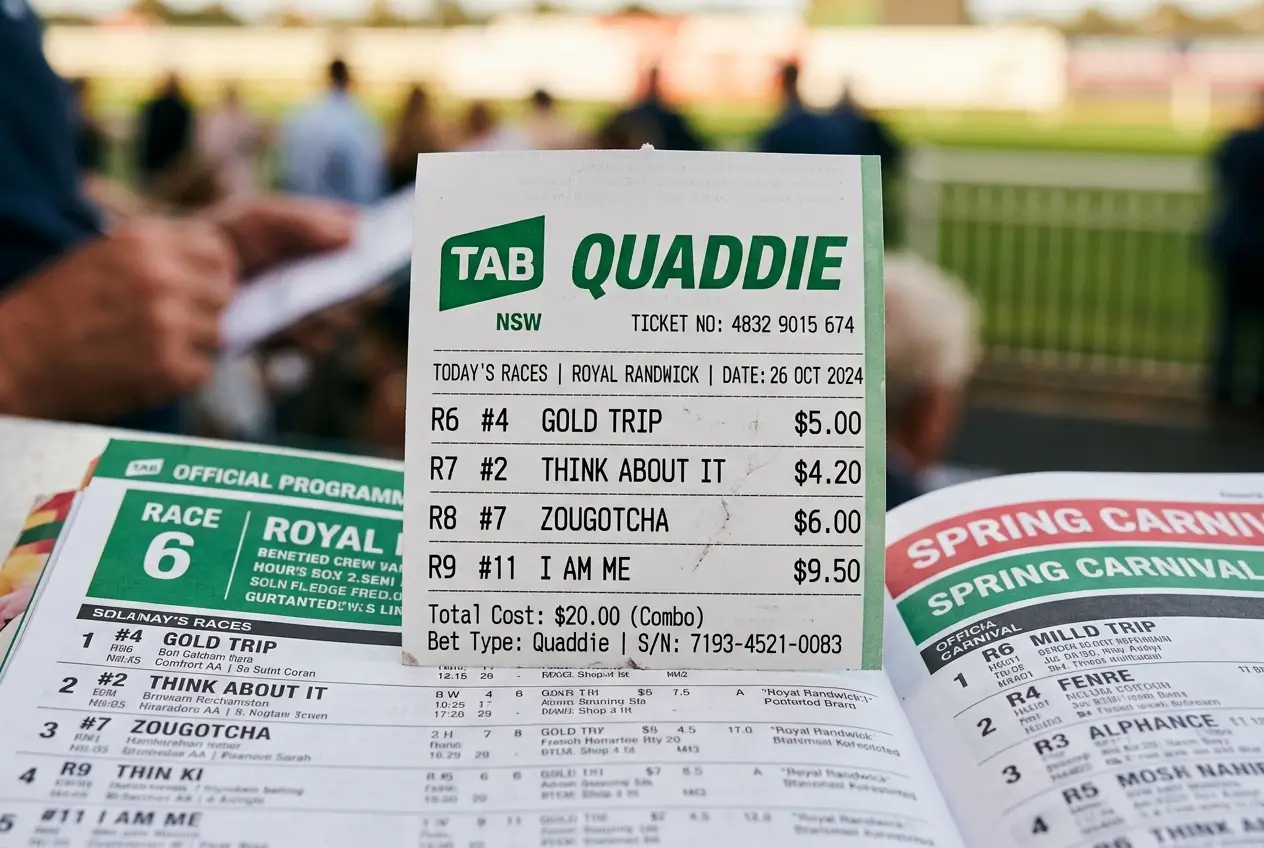
Quaddie vs quadrella — are they the same thing?
Yes, and also no. The two words describe the identical bet, but they carry different registers. “Quadrella” is the formal name — the one you’ll see in official TAB documentation, racing industry reports, and the kind of careful writing that wants to avoid sounding too colloquial. “Quaddie” is what people actually say. Think of it the way British punters distinguish between “accumulator” in a written terms-and-conditions document and “acca” in a text message to a mate before the first race.
The practical consequence is that if you’re searching for information about the bet in an Australian context, either term will work. The formal race previews in the Australian press tend to use “quadrella” when describing the nominated legs (“the quadrella races are races 5, 6, 7 and 8”), while the same writers will switch to “quaddie” when talking about the experience of betting it (“I had the quaddie sewn up until the last leg”).

In a British context, neither term maps cleanly onto an existing Tote product. The closest structural equivalent is the Tote Quadpot — which asks you to find a placed runner (not necessarily the winner) in races 3 through 6 — or the Pick 4, which does require winners across four designated races. But neither of those is called a “quaddie,” and a British punter who walks up to a Tote window and asks for “a quaddie” will either get a blank look or a patient explanation that the product they’re after goes by a different name here.

From slang to established betting term
One thing that strikes me after eight years working in this space is how rapidly Australian racing terminology has spread into British and Irish racing coverage — largely through the internet. Racing content from Australia is abundant, detailed, and produced by people who take the craft of form analysis seriously. When British punters started looking for multi-race pool betting guides in the early 2010s, much of the best material they found was Australian, written for an Australian audience, using Australian terminology.
The result is a vocabulary gap. Australian betting turnover on thoroughbred racing ran to approximately A$29 billion in the 2022 financial year, which reflects an industry that has developed deep, specialist content around every aspect of pool wagering. The term “quaddie” is so embedded in that content ecosystem that it now reads as generic rather than geographically specific — even though it remains, technically, a piece of Australian slang that describes an Australian product.

For British punters, the practical takeaway is this: when you see “quaddie” in a headline, a tip sheet, or a racing forum, you are almost certainly looking at Australian content describing an Australian pool. The British equivalents — Quadpot, Pick 4, Placepot, Jackpot — have their own terminology, their own history, and their own structural quirks. Understanding that “quaddie” is a specific Australian word, not a universal racing term, is the first step towards navigating that distinction cleanly.
The word’s journey from a Tasmanian newspaper in 1978 to a globally recognised betting term is a small but neat illustration of how racing culture moves: not through official channels, but through the accumulated weight of track conversation, punter shorthand, and eventually the internet pulling it all into one place. If you want to explore how that betting terminology connects to the wider world of pool betting language, the quaddie betting terms glossary covers the full vocabulary in one place. What Britain calls it instead: the UK equivalent.

Is ‘quaddie’ the same as ‘quadrella’?
Yes. ‘Quaddie’ is the everyday abbreviation of ‘quadrella,’ the formal name for the four-leg pool bet. Both words describe the identical wager — pick the winner of four designated races at a single meeting — and are used interchangeably in Australian racing, with ‘quaddie’ being the more common spoken and written form.
Is ‘quaddie’ an Australian word?
It is. The Oxford English Dictionary records the first use of ‘quaddie’ in 1978 in a Tasmanian publication. The bet and its name developed within the Australian TAB pari-mutuel system and remain Australian in origin, even though the word is now widely used in international racing coverage.
When was the word ‘quaddie’ first recorded?
The earliest documented use is from 1978, according to the Oxford English Dictionary, traced to the King Island/Tasmania News. The full form ‘quadrella’ was in use before this date, but ‘1978’ is the confirmed earliest citation for the abbreviated ‘quaddie’ specifically.
This material was created by the FourCast team.
Related posts

Quaddie Tips: How to Read, Judge and Use Daily Selections
Pool Betting vs Fixed Odds: Where the Value Evidence Points