
Quaddie vs Quadpot: How the Two Four-Leg Pool Bets Differ
 Available in US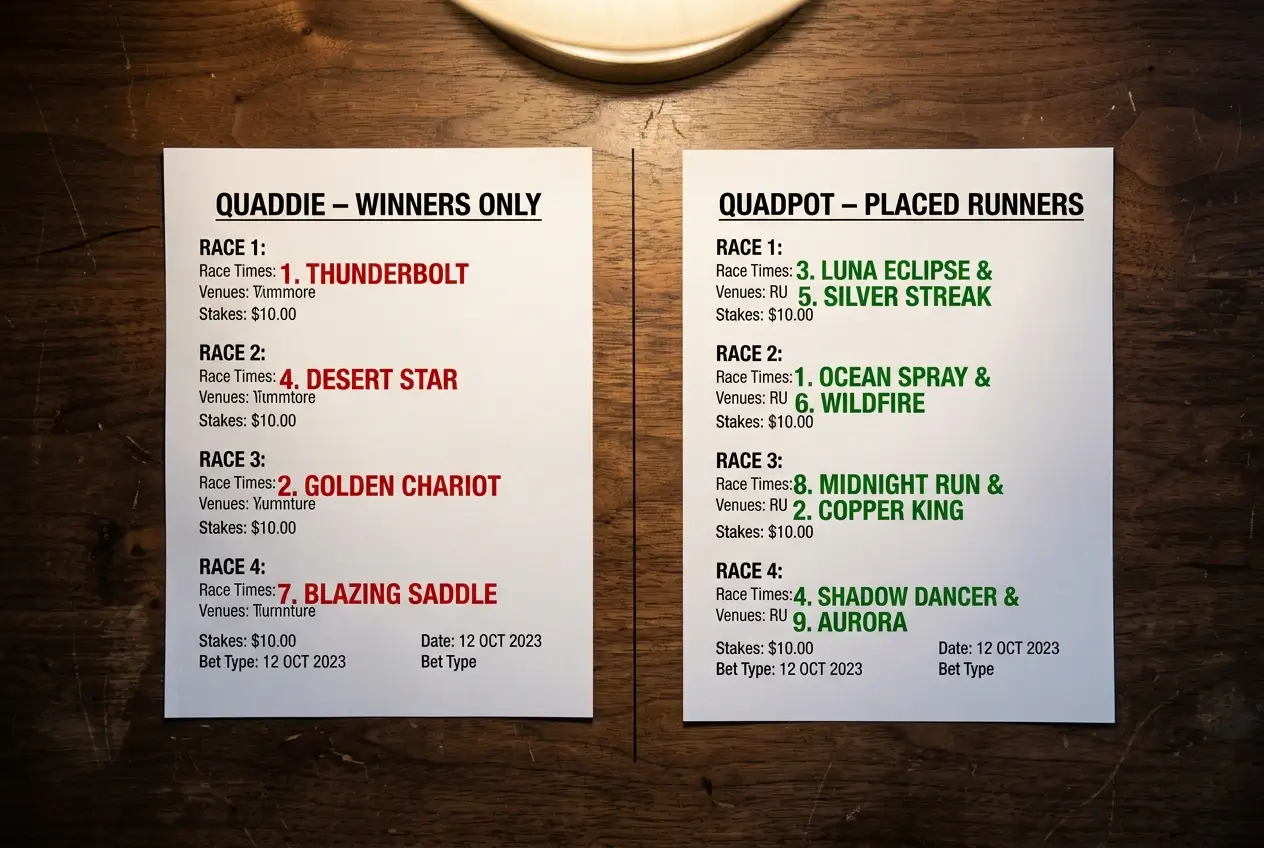
One Bet, Two Names, One Critical Difference
At first glance, the Australian quaddie and the UK Tote Quadpot look like the same bet under different names. Both cover four nominated races at a single meeting. Both operate as pari-mutuel pools. Both require a selection in each of the four legs and pay a dividend to winning tickets. But the difference that separates them — winners versus placed runners — changes the character of each product completely, from how difficult it is to win to how large the dividends can get. The full picture is in our complete guide to quaddie betting.
I work with both systems regularly in my role as a UK pool betting analyst, and the confusion between these two products is one of the most persistent misunderstandings I encounter. A British punter who has been reading Australian racing content — Cup day coverage, TAB pool guides, anything from the major AU betting sites — will arrive expecting to find “the quaddie” when they look for UK pool products. What they find instead is the Quadpot and its family. Understanding exactly how these two products diverge makes you a more informed bettor in both systems, not just one.
This comparison is specifically between the Australian-style quaddie (Pick 4 winners) and the UK Tote Quadpot (Pick 4 placed runners). The Placepot — another UK pool product — differs from both on the number of races covered and will be referenced for context but is covered in detail separately.
Winners Versus Placed Runners: The Core Distinction
The Australian quaddie is a pure Pick 4 winners product. Your four selections must win their respective races. Finish second? Dead. Finish a close third in a ten-runner race? Dead. There is no consolation for a placed runner — the bet is entirely predicated on four first-place finishes in the four nominated legs. This strictness is what makes the Australian quaddie simultaneously harder to win and more rewarding when it does land: only tickets containing all four winners collect, which means the pool divides among a smaller number of winning tickets.
The UK Tote Quadpot accepts placed runners. Specifically, your selection must finish in the places as defined by standard Tote place terms for that race’s field size. The standard scale is: first or second in fields of five to seven runners; first, second or third in fields of eight to fifteen; and first, second, third or fourth in certain large handicap fields. This means a horse that runs second in a twelve-runner handicap keeps your Quadpot ticket alive, even though it would have killed an Australian-style quaddie leg.
What this means for win probability
The practical effect is significant. In a typical eight-runner race, a selection finishing in the top three constitutes a placed finish. That means your runner has three ways to survive the leg — win, or finish second, or finish third — rather than just one. In a twelve-runner field with four-place terms, your runner has four ways to stay alive.
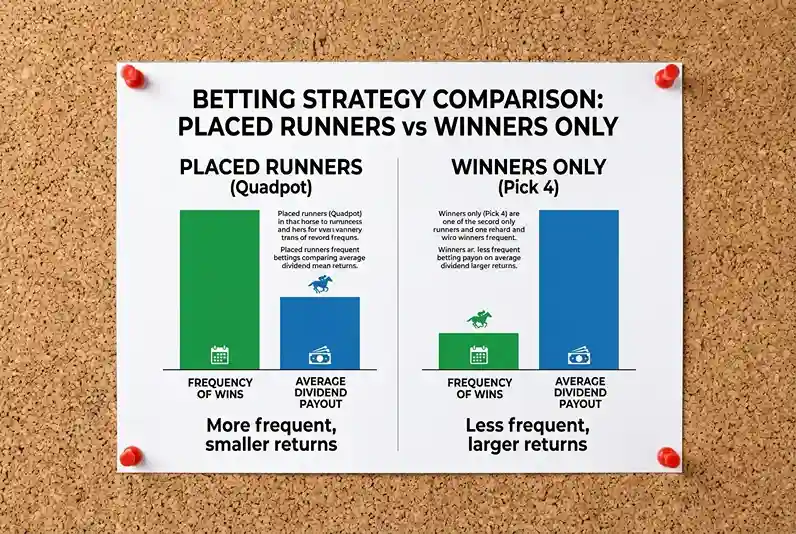
This does not make the Quadpot easy — surviving four legs in a row with placed runners is still challenging, particularly at competitive meetings where heavy handicaps produce wide-open results. But it does produce a markedly different win frequency compared to a winners-only quaddie. You will cash Quadpot tickets more often than you would land pure four-winners tickets from the same card, all else being equal.
The counterbalance: because more tickets survive — more punters’ selections “place” across four legs than “win” across the same four legs — the pool divides among more winning units. Dividends are typically lower for the Quadpot than they would be for a pure-winners product on the same card. The Quadpot trades dividend size for win frequency. Whether that trade-off suits you depends entirely on your preference for return profile.
The Pick 4 alternative
The Tote and Britbet also offer a “Pick 4” product, which is the strict winners variant — your selection must win its race in every leg. Pick 4 is structurally identical to the Australian quaddie in its winner requirement, though the nominated races and UK-specific pool mechanics apply. If you are specifically looking for the winners-only pari-mutuel experience that the Australian quaddie provides, UK Pick 4 is your product. For the broader placed-runner coverage that makes the bet more survivable on a competitive British card, the Quadpot is the choice.
No placed runner? No payout
One point worth stating clearly: in the Quadpot, if your selection finishes outside the placed positions, your ticket dies on that leg — just as it would in an Australian quaddie if your selection did not win. The “placed runner” qualification is a genuine requirement, not a soft backup. In a two-runner race where only one runner qualifies as placed, a non-placing selection still kills the leg. This is an important distinction from the Placepot, which uses the first six races of the meeting and operates under slightly different rules. For the full Placepot structure, the Tote Placepot guide covers this in detail.
Which Races Each Bet Covers
The nominated races are another structural difference — and for UK punters, the Quadpot’s race selection has practical implications for how you build your ticket and when you need to place it.
Australian quaddie: typically the last four races
In Australia, the quaddie is traditionally nominated over the last four races of the meeting — or sometimes a selected block of four from the card, depending on the operator and the meeting. On a typical eight-race TAB meeting, the quaddie would cover races 5 through 8. This end-of-card positioning means punters have the advantage of watching the early races to assess track conditions, jockey form on the day, and any patterns in how horses are travelling before committing their quaddie stakes.
Some Australian meetings offer an “early quaddie” over the first four races of the card as a separate product with its own pool. The early and main quaddies are independent — you can bet both if you want, in separate pools with separate dividends.
UK Quadpot: races 3 through 6
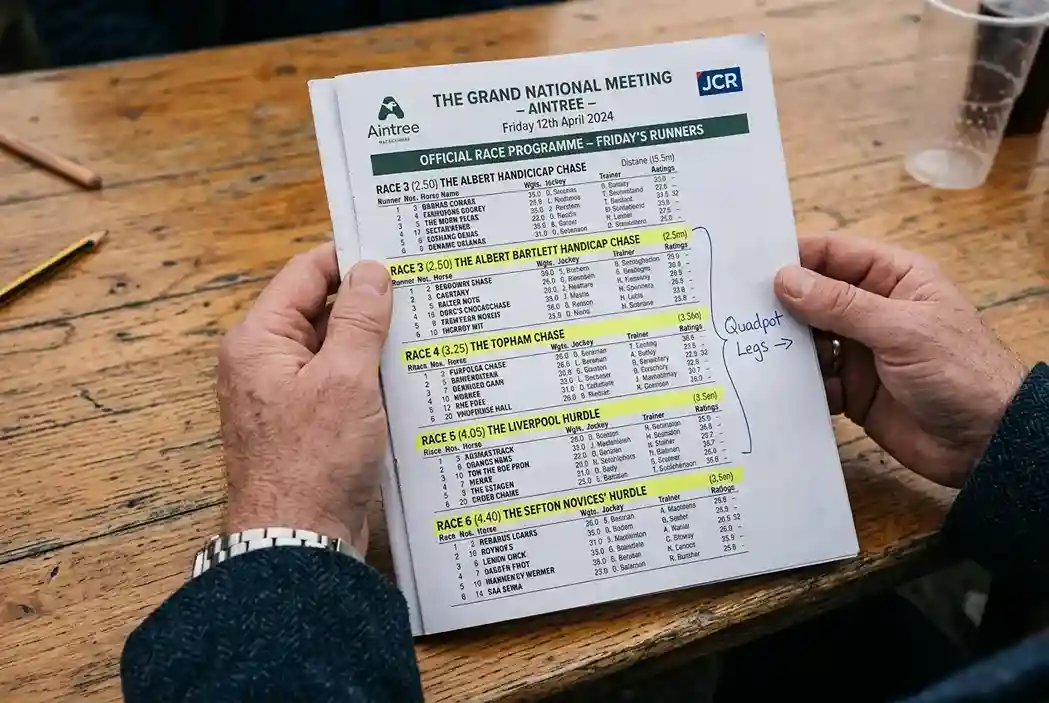
The Tote Quadpot is fixed to races 3, 4, 5 and 6 of the meeting — the middle four races, not the last four. This is a deliberate structural choice. It leaves races 1 and 2 as observation races before the pool locks, giving punters two runs of form to process before the Quadpot opens. And it leaves the final races of the card — often the feature race or the card’s strongest handicap — outside the Quadpot structure, which can actually be advantageous: the most contested races are not included, so you are not forced to navigate them as part of your four-leg bet.
The practical consequence: you must confirm your Quadpot ticket before race 3 goes off. If you are at the track, that means having your selections ready by the end of race 2. If you are betting online or in-app, allow a few minutes before the race 3 scheduled off time. There is no late entry once the pool closes.
UK Placepot: races 1 through 6
The Placepot, for context, covers the first six races of the meeting — all six, starting from race 1. This is one of the key differences between Quadpot and Placepot: the Placepot covers six races (not four) and requires placed runners throughout, while the Quadpot covers four races starting from race 3. The Placepot is harder to land simply because it covers more legs, but it also offers the daily £50,000 guaranteed pool minimum, and at premium festivals the guaranteed pool rises to £1,000,000 per day.
Race type and field sizes
Both the Australian quaddie and the UK Quadpot are affected by the types of races nominated. Group and Listed races with small, high-quality fields tend to produce cleaner outcomes (the form is often clearer, field sizes are smaller, fewer combinations are needed for coverage). Large-field handicaps are the opposite: 20-plus runners with close weights, mixed recent form, and genuine uncertainty about the result. UK Quadpot legs are drawn from the full range of British racing — flat and jump, small field and large — which means the product varies considerably in difficulty from meeting to meeting. A midweek all-weather card at a minor track will usually have smaller fields and tighter form than a Saturday turf meeting at a major venue.
Cost and Frequency of Returns
The most practical question for any punter is: how often will I win, and how much will I win when I do? These two variables sit in direct tension in pool betting — more frequent winners means smaller dividends, and rarer winners means larger dividends. The quaddie and Quadpot sit at different points on this spectrum.
How often does each product pay?
The Australian quaddie, being a pure winners product, pays less frequently than the Quadpot by construction. Four winners in four races — especially across a full race card with competitive fields — is a harder task than four placed runners. On a typical competitive meeting, many thousands of punters are betting each leg of the quaddie, and most will be beaten in at least one leg. The pool can occasionally rollover if no one picks all four winners (in the “terminating” variant, a consolation dividend is paid; in the rollover variant, the pool carries forward).
The Quadpot — with placed-runner qualification — pays out at most UK meetings because the placed-runner requirement gives each leg multiple survival outcomes. The dividend on a typical UK card reflects this: the pool divides among a larger number of winning tickets, keeping individual payouts more modest. The average Placepot dividend in 2023 across UK meetings was £466 per £1 unit, with festival days averaging much higher — Cheltenham Festival days averaged over £7,126 per unit across the 2020–2024 period. The Quadpot’s typical dividend range is lower than the Placepot’s (the Placepot covers six races and therefore has fewer winners), but it is more regular in its payouts.
The guaranteed pool floor
The Tote guarantees a minimum daily Placepot pool of £50,000. At Cheltenham Festival, the guarantee rises to £1,000,000 per day across all four days. This guarantee does not apply to the Quadpot in the same way — the Quadpot pool is built from actual stakes without a declared minimum. This means Quadpot pools at smaller meetings can be quite modest, which produces more variable dividend outcomes. A small pool with a relatively unusual result (several non-favourites placing) can pay a very large dividend; a small pool with predictable results pays very little.
The implication for punters: the Placepot is the more reliable product in terms of pool depth at major meetings. For the Quadpot, dividend size is more dependent on the individual meeting’s draw and betting activity.

Combination cost comparison
Cost mechanics are identical in both products — combinations multiplied by unit stake, with Flexi available to scale down the investment. A 3×3×3×3 ticket costs £81 at full unit in UK Quadpot terms, just as it would cost A$81 in an Australian quaddie. The minimum stake of £2 at the UK Tote applies to the total investment, so you can cover 81 combinations for £2 at a Flexi percentage of approximately 2.5% — which is technically valid but produces a very small dividend share if you win.
Where the cost calculation differs is in the baseline probability of each combination being a winner. Because placed runners qualify in the Quadpot, the probability that any given combination lands is higher than in the winners-only quaddie. This means you need fewer combinations to achieve equivalent coverage, which can allow tighter ticket structures without sacrificing win probability in the same way that a winners-only product would demand.
Which One Should You Bet?
Alex Frost, Chief Executive of UK Tote Group, has described 2025 as “a really successful year for World Pool” — a reference to the record volumes flowing through the UK’s pari-mutuel infrastructure. That growth is partly driven by punters recognising that pool products offer a distinct value profile from fixed odds, and partly by a clearer understanding of which product suits which type of punter and card.
The honest answer to “which should I bet?” is that it depends on three things: your risk appetite, the character of the race card, and what you are trying to achieve.
Choose Quadpot (placed runners) when:
- You want more regular small-to-medium returns and can tolerate lower average dividends in exchange for a higher win frequency.
- The races 3–6 on your chosen card look competitive with no standout favourites — placed-runner qualification gives you more survivability in open fields.
- You are newer to multi-race pool betting and want to build experience at a lower variance before moving to winners-only products.
- The card is at a major UK meeting where Quadpot activity is higher and dividends are more meaningful.
Choose Pick 4 (winners only) when:
- You are looking for the pure quaddie experience and want winners-only coverage with potentially larger dividends.
- You have strong convictions on all four legs and believe the form clearly points to winners — not just placed runners — across each race.
- You are deliberately aiming for a higher-variance outcome and want to participate in a pool where the winning universe is smaller (and therefore potential payouts are larger).
- You are comparing directly with Australian quaddie mechanics and want a like-for-like product structure.
The value dimension
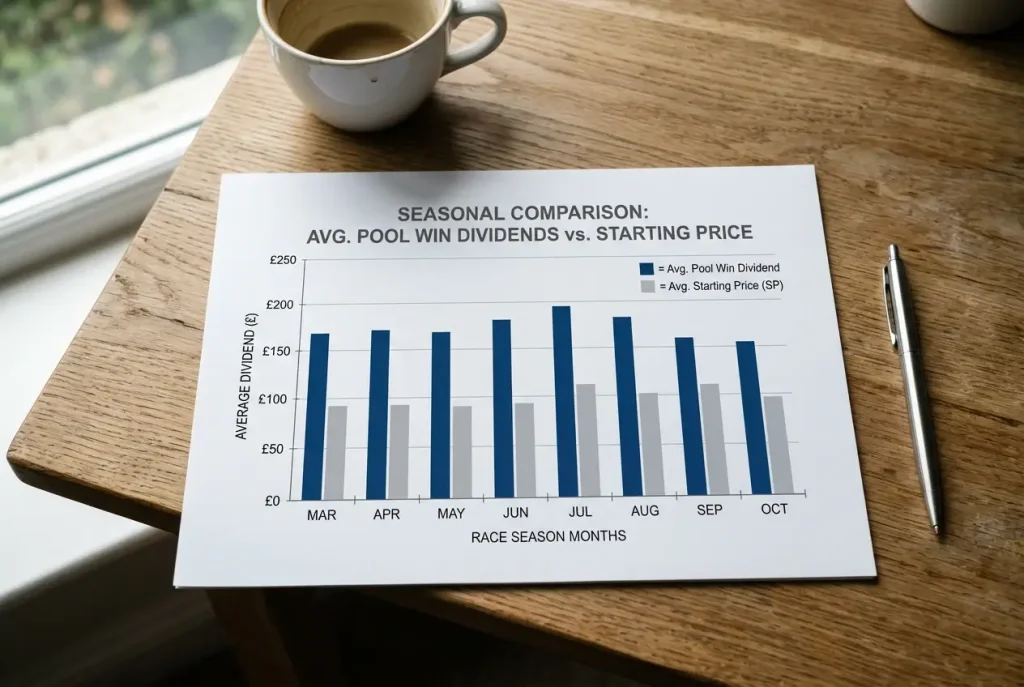
From a pure pool value standpoint, the pari-mutuel structure rewards results that the mass of punters under-bet. The data from UK Tote pools shows clearly that pool products outperform Starting Price on a systematic basis: across World Pool days in 2025, the cumulative return on every winner via the Tote was £171.44 per winner more than the equivalent Starting Price. This value advantage exists in both Quadpot and Pick 4 — it derives from the pool mechanism itself, not from which type of runner qualifies per leg.
For pool betting regulars, the decision between Quadpot and Pick 4 is ultimately a form-reading question: do you trust your selections to win outright (Pick 4), or would you rather have the placed-runner safety net at the cost of lower dividends (Quadpot)? Neither answer is universally better. A week where your top selections keep finishing second will leave you delighted with Quadpot returns and frustrated with a Pick 4. A week where your selections win cleanly will produce identical outcomes from either product — because a winner always counts as a placing too.
Running both
It is entirely possible — and sometimes sensible — to bet both a Quadpot and a Pick 4 on the same card. Your Pick 4 covers the strict winners scenario; your Quadpot provides additional income if some of your selections place without winning. The total cost doubles, but so does your coverage. Experienced UK pool bettors on competitive cards sometimes adopt this “both products” approach at major meetings where the pools are deep and dividends meaningful. Just make sure you calculate the combined cost before placing — the two products add together, and a wide ticket in both can quickly become expensive.

Side-by-Side Summary
After eight years of working with both products across UK and Australian racing, here is the direct comparison I would give anyone trying to choose between the two or understand the relationship.
| Feature | Australian Quaddie | UK Tote Quadpot |
|---|---|---|
| Leg requirement | Winners only | Placed runners |
| Races covered | Typically last 4 races | Races 3–6 (middle 4) |
| Pool type | Pari-mutuel (TAB) | Pari-mutuel (Tote/Britbet) |
| Minimum stake | A$0.50–A$1.00 per combination | £2.00 total |
| Flexi betting | Yes — % of full unit | Yes — % of full unit |
| Win frequency | Lower (winners only) | Higher (placed runners) |
| Typical dividend range | A$50–A$500,000+ | £10–£1,000+ |
| Pool guarantee | Operator-dependent | No declared minimum |
| Rollover structure | Yes (in some variants) | No rollover |
| UK winners equivalent | N/A | Tote Pick 4 |
The table confirms what the text has established: these are structurally similar products running under the same pari-mutuel logic, but their qualification rules create different risk-return profiles. The quaddie is harder to win; the Quadpot is softer. The quaddie’s dividends can be more extreme at the top end because fewer tickets survive; the Quadpot tends to be more consistent.
Neither product is superior in absolute terms. The Australian quaddie has a half-century of tradition behind it and, at major meetings, can produce truly extraordinary dividends on the back of multiple long-priced winners. The UK Quadpot is well-suited to the character of British racing — competitive fields, tight handicapping, form that does not always resolve to a clear winner. Both reward careful ticket construction over careless selection, and both participate in a pari-mutuel system that, on the evidence of recent UK pool data, consistently offers better returns on non-favourite outcomes than the equivalent fixed-odds market.
If you are a British punter who has been following Australian quaddie content and wondering where the equivalent product is — the Quadpot and Pick 4 are your answer. The exact rules differ, the races are different, and the dividends are in sterling not Australian dollars. But the logic of the bet — cover four races in one pool, share the dividend with the other winners — is exactly the same. The British bet in full: the Tote Quadpot.
Frequently Asked Questions
Does a Quadpot pay out if my horse only places?
Yes. The Quadpot requires placed runners, not winners. If your selection finishes in the places as defined by standard Tote place terms for that race’s field size — typically first or second in small fields, first, second or third in medium fields, and first through fourth in larger handicaps — your leg survives. You do not need the horse to win outright.
How many legs does a Quadpot have compared with a quaddie?
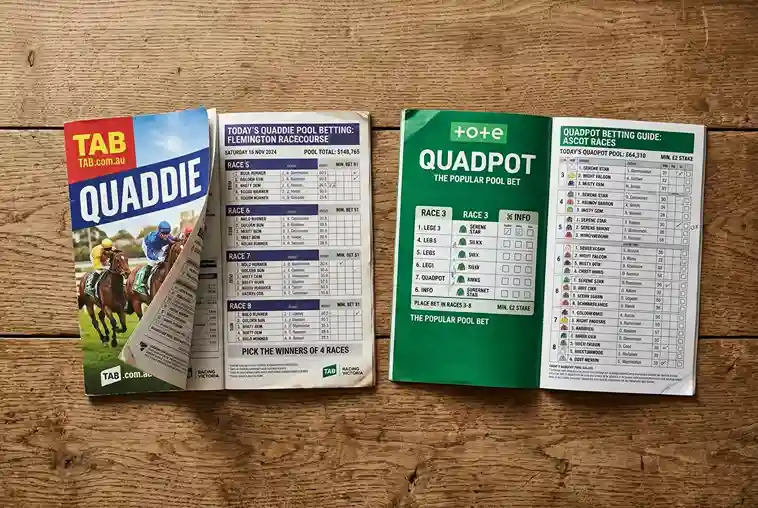
Both have four legs. The Australian quaddie covers four races (typically the last four of the meeting or a nominated block of four); the UK Quadpot always covers races 3, 4, 5 and 6. The number of legs is identical; what differs is which races are nominated and whether winners or placed runners are required.
Which is easier to win, a quaddie or a Quadpot?
The Quadpot is easier to win on a run-for-run basis because it accepts placed runners rather than winners. In a typical eight-runner race, your selection has three chances to survive (first, second, or third) rather than just one. The trade-off is lower dividends: more tickets survive each leg, so the pool divides among more winning units, reducing the payout per winning ticket.
Can the same four races count for both a quaddie and a Quadpot?
In the UK context, the same four races (3 through 6) underpin both the Quadpot and the Pick 4 product. You can bet both products on the same four races if you wish — they are separate pools with separate dividends. The Quadpot counts placed runners and the Pick 4 counts winners only. Betting both doubles your stake but gives you two distinct pools to collect from.
This material was created by the FourCast team.
Related posts

Quaddie Tips: How to Read, Judge and Use Daily Selections
Pool Betting vs Fixed Odds: Where the Value Evidence Points