How to Calculate a Quaddie: Combinations, Unit Cost and Flexi Percentages
 Available in US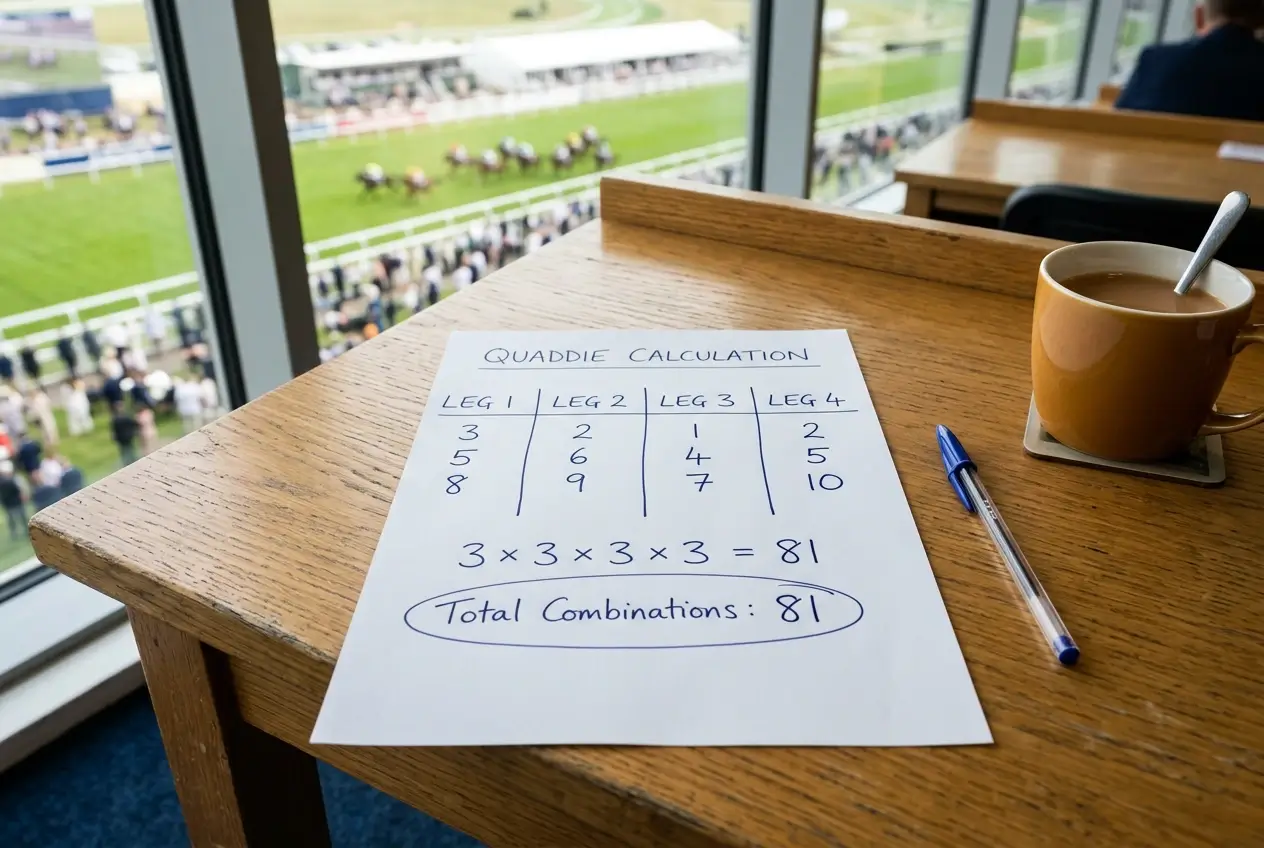
Two Numbers, One Bet
Every quaddie calculation comes down to two numbers: how many combinations you are covering, and what that coverage costs at a full unit stake. Once you have those two numbers locked in, Flexi betting lets you uncouple the stake from the full-unit price entirely — so you can cover 81 combinations for a fiver rather than £81, if that is all your budget allows. he full picture is in our complete guide to quaddie betting.
I have spent eight years working through pool-bet maths on British and Australian cards, and the question I get most often is not “which horse should I pick?” It is “why does my quaddie cost so much?” The answer is almost always the same: the punter multiplied their selections correctly but missed the second step — the unit cost — and did not know Flexi existed to solve the problem.
This guide walks through how to calculate a quaddie from scratch: counting combinations leg by leg, pricing the full unit, and then using Flexi percentages to fit any budget. Every step gets a worked example with real numbers. Jon Knapman, International Chief Commercial Officer at Tote, has called the pool “a truly global betting event with fantastic value” — but you only realise that value if you know what you are actually buying with each pound you stake.
The maths here applies equally to the Australian quaddie and to the UK’s closest equivalent, the Tote Quadpot — the structure of four legs and a shared pari-mutuel pool is identical in both cases. Where UK-specific figures differ (minimum stakes, dividend currency) I will flag them clearly.
Counting the Combinations
The first time I tried to build a quaddie, I made the mistake almost every newcomer makes: I thought “four legs, three horses each” meant I was backing twelve runners. It does not. You are backing every possible path through those four legs simultaneously — and the number of paths grows fast.
The rule is simple: multiply the number of selections in each leg together. If you pick three runners in leg one, three in leg two, three in leg three, and three in leg four, the calculation is:
3 × 3 × 3 × 3 = 81 combinations
That is the standard 3×3×3×3 quaddie — 81 combinations, each of which is a unique four-horse path that must be covered. Now watch what happens when you add just one runner to a single leg:
4 × 3 × 3 × 3 = 108 combinations
Add one horse to two legs:
4 × 4 × 3 × 3 = 144 combinations
Cover five runners in two legs:
5 × 5 × 3 × 3 = 225 combinations
That last ticket — five runners in two wide-open legs, three in the other two — costs nearly three times as much as the base 3×3×3×3. The combination count is what drives cost more than any other factor in quaddie construction.
What counts as a “selection”?
Each horse you mark on the quaddie form — or select in the Tote app — counts as one selection in that leg. If you take the whole field in a ten-runner race, that leg contributes 10 to the multiplication. A single runner (sometimes called a banker or standout) contributes 1, effectively not adding to cost at all for that leg.
Consider a ticket with one banker in leg one, then selections of 2, 3, and 4 across the remaining three legs:
1 × 2 × 3 × 4 = 24 combinations
That is a modest 24-combination ticket — manageable on almost any budget. This is the “anchor and spread” approach in maths terms: you sacrifice coverage in your most confident leg to buy width in the legs where the race looks open.
Combinations table for common configurations
Rather than recalculating from scratch each time, it helps to have a quick reference. The table below shows combination counts for some of the most common four-leg structures:
| Leg 1 | Leg 2 | Leg 3 | Leg 4 | Combinations |
|---|---|---|---|---|
| 1 | 1 | 1 | 1 | 1 |
| 1 | 2 | 3 | 4 | 24 |
| 2 | 2 | 2 | 2 | 16 |
| 2 | 3 | 3 | 3 | 54 |
| 3 | 3 | 3 | 3 | 81 |
| 4 | 3 | 3 | 3 | 108 |
| 4 | 4 | 3 | 3 | 144 |
| 4 | 4 | 4 | 4 | 256 |
| 5 | 4 | 3 | 2 | 120 |
| 5 | 5 | 3 | 3 | 225 |
| 6 | 5 | 4 | 3 | 360 |
Notice how a 4×4×4×4 ticket — only one extra runner per leg versus the 3×3×3×3 base — triples the combination count from 81 to 256. That difference is not intuitive until you see it laid out like this. The maths punishes “just one more” additions far more harshly than most punters expect.

Ordering your legs by confidence
When I am building a ticket, I sort my four legs by how wide I want to go — narrowest (highest confidence) first in my notes, widest (most open) last. It does not change the arithmetic — multiplication is commutative — but it makes it easier to spot where the cost is coming from. If the widest leg is a 6-runner contribution, that is the place to cut first if budget is tight.
One further point: scratching (a horse being withdrawn after you have placed your bet) reduces your combination count and triggers a refund of the relevant portion of your stake in most Australian pools. The UK Quadpot and Tote pools handle scratching through their standard non-runner rules. Always check the operator’s policy before the first leg goes off.
Working Out the Full Unit Cost
Here is the part that trips people up most often. You have counted your combinations — let’s say 81. What does that actually cost you?
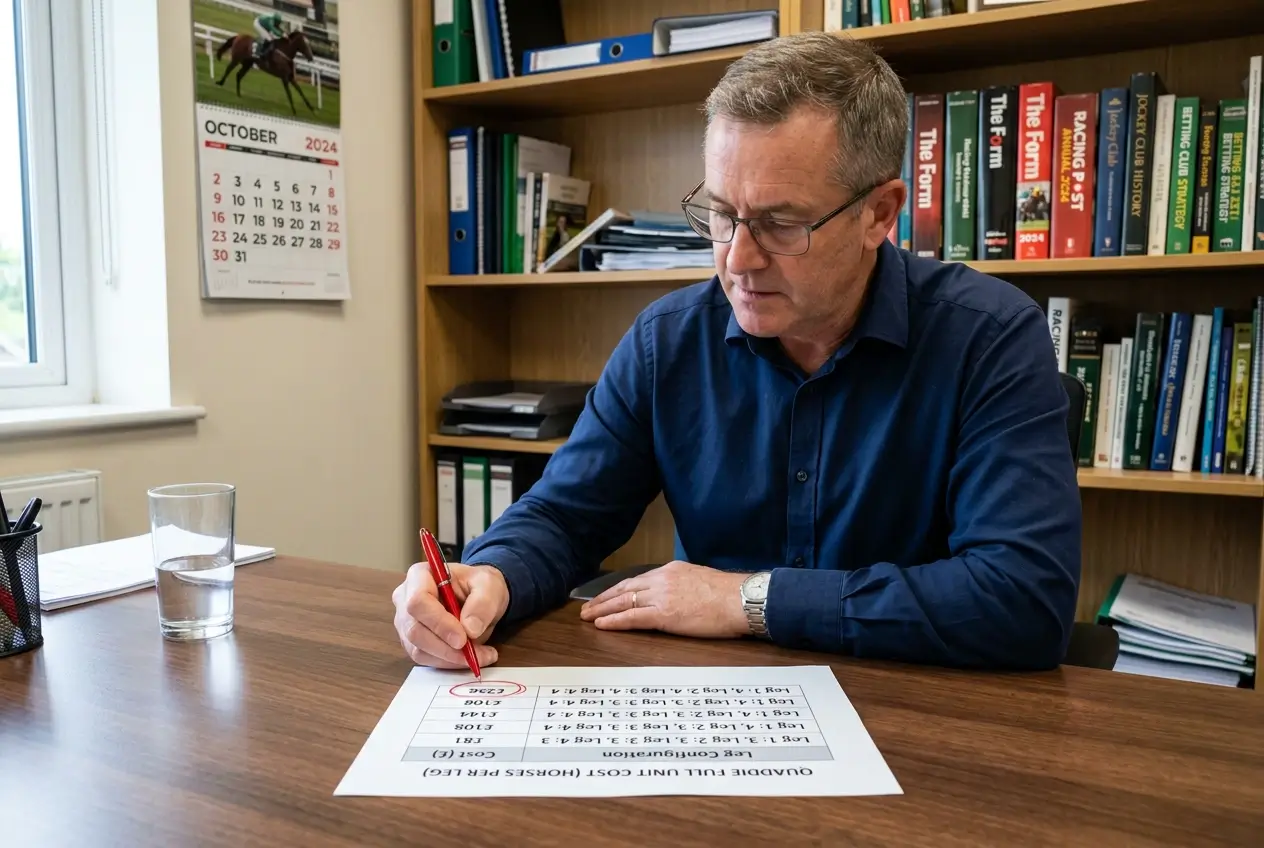
The full unit cost is simply your combination count multiplied by the minimum unit stake. In Australia’s TAB pools, the base unit is typically A$1. In the UK, the Tote’s minimum stake across all its pool products is £2. But — and this is critical — you do not automatically have to stake £2 per combination. That is where Flexi comes in. For now, let’s establish the full-unit baseline.
Full unit cost formula
Full unit cost = combinations × unit stake
For the standard 3×3×3×3 ticket at A$1 per combination:
81 × A$1.00 = A$81.00 for a full unit
At £1 per combination in a UK context:
81 × £1.00 = £81.00 for a full unit
That is the “full unit” — the amount you need to spend in order to receive 100% of any dividend the pool declares. A full unit guarantees that if your four selections all come in, you collect the entire declared dividend without any reduction.
What happens at 4×4×4×4?
Using the same formula:
256 × A$1.00 = A$256.00
At UK stakes:
256 × £1.00 = £256.00
That is a meaningful sum for a single meeting’s exotic bet. And yet plenty of punters construct tickets this wide, either not realising the cost or relying on Flexi to bring it back to something manageable. The full unit cost is the reference number — Flexi is the mechanism that lets you scale it.
Cost grows exponentially with selections
A useful way to feel the scale of the problem is to imagine you keep adding one runner to one leg of a 3×3×3×3 ticket in sequence:
- Start:
3×3×3×3 = 81— £81 full unit - Add one to leg 1:
4×3×3×3 = 108— £108 full unit (+33%) - Add one to leg 2:
4×4×3×3 = 144— £144 full unit (+78%) - Add one to leg 3:
4×4×4×3 = 192— £192 full unit (+137%) - Add one to leg 4:
4×4×4×4 = 256— £256 full unit (+216%)
Starting from £81 and ending at £256 by adding a single horse to each leg in turn — that is the mathematics of multiplicative growth. Each additional runner multiplies the whole ticket, not just the leg it belongs to.
The minimum stake floor
In UK pool betting, the Tote accepts a minimum total stake of £2. That does not mean each of your 81 combinations gets £2 — it means your total investment across all combinations must reach at least £2. This is where Flexi percentage becomes the operating lever: you can put £2 into 81 combinations, but each combination then represents a tiny fraction of a full unit, and your dividend payout is scaled accordingly.
On Australian TAB-style pools, the minimum per combination is typically A$0.50 (sometimes A$1.00 depending on the operator). The concept is identical: the minimum per combination determines how far you can stretch your total budget across a wide ticket.
Why “full unit” matters
The full unit is the anchor for every dividend calculation. When a quaddie pool declares, say, A$512 to a A$1 unit — as the Melbourne Cup quaddie did in 2024 — that figure is the full-unit dividend. If you held a A$0.50 per combination ticket (i.e., 50% Flexi), you receive A$256 on each winning combination you covered. Every Flexi calculation flows from this full-unit anchor, which is why I always establish it first before working backwards to what my budget actually buys.
Flexi Percentage Explained
Flexi is, genuinely, one of the best ideas in pool betting — and also one of the most misunderstood. When I explain it to someone for the first time, the usual reaction is: “so I can cover more horses for the same money?” Yes, exactly. The trade-off is that your payout is reduced in proportion to how far below a full unit you go.
What Flexi percentage means
When you take a Flexi percentage, you are buying a fraction of a full unit across all your combinations. A 100% Flexi is simply a full unit — you receive 100% of the declared dividend per winning combination. A 50% Flexi means you have paid half the full-unit cost, and you will receive 50% of the declared dividend if your combination wins. A 12.5% Flexi means you have paid 12.5% of the full-unit cost and stand to receive 12.5% of the declared dividend.
The formula:
Flexi stake = full unit cost × (Flexi % ÷ 100)
For the 81-combination 3×3×3×3 ticket at a 25% Flexi:
£81.00 × 0.25 = £20.25 total stake
And your payout if you win:
£20.25 stake → 25% of declared dividend per winning combination
Working backwards: finding the Flexi% for a given budget
More practically useful is working backwards from a budget. You have £15 and want to cover 81 combinations. What Flexi percentage does that buy?
Flexi % = (target spend ÷ full unit cost) × 100
Flexi % = (£15 ÷ £81) × 100 = 18.5%
An 18.5% Flexi on a winning ticket means you collect 18.5% of whatever the pool declares to a full unit. If the dividend is £500 per unit, you receive £92.50.
Now consider a real UK data point: in 2025 the largest Placepot dividend came in at £26,424.30 at Royal Ascot — a pari-mutuel pool structurally similar to the quaddie family. An 18.5% share of that figure would be £4,888. From a £15 stake. That is not a guarantee — most weeks the Placepot and Quadpot dividends are far more modest — but it illustrates what Flexi coverage of a long-price pari-mutuel pool can look like when things go right.

Flexi percentage and the minimum stake
There is a practical floor on how small a Flexi percentage you can take. The Tote requires a minimum total stake of £2. If your full unit cost is £81, the smallest Flexi that satisfies the minimum is:
Minimum Flexi % = (£2 ÷ £81) × 100 = 2.47%
Operators typically require the Flexi percentage to be a round number or meet a minimum threshold — check the specific platform’s rules, as this varies. At 2.47%, the maths works but the payout on a winning ticket is obviously a tiny fraction of the full dividend. In practice, most serious pool punters aim for at least 10–25% Flexi to keep a meaningful share of any big dividend.
How Flexi interacts with your overall staking plan — how to size your investment per meeting relative to a bankroll — is covered in detail in the quaddie staking plan guide.
Flexi examples at different combination counts
| Combinations | Full unit cost | 25% Flexi stake | 10% Flexi stake | 5% Flexi stake |
|---|---|---|---|---|
24 |
£24.00 | £6.00 | £2.40 | £1.20 * |
54 |
£54.00 | £13.50 | £5.40 | £2.70 |
81 |
£81.00 | £20.25 | £8.10 | £4.05 |
144 |
£144.00 | £36.00 | £14.40 | £7.20 |
256 |
£256.00 | £64.00 | £25.60 | £12.80 |
* Below the UK Tote minimum of £2 — would require rounding up to satisfy the floor.
This table is worth bookmarking. It shows at a glance that a 256-combination ticket at 10% Flexi costs £25.60 — roughly the same as an 81-combination ticket at 31% Flexi (£25.11). Whether you prefer narrower coverage at higher percentage or wider coverage at lower percentage depends on your view of the race — but the maths behind both options is identical.
Does Flexi affect whether you win or lose the bet?
No. Flexi only affects the payout, not the outcome. If your four selections win their races, you win the quaddie regardless of your Flexi percentage. A 5% Flexi on 256 combinations is still a winning ticket if all four come in — you just receive 5% of the dividend rather than 100%. The Flexi mechanism is purely a staking tool; it does not change whether your ticket is a winner.
Scaling Cost to Your Budget
Knowing the maths is one thing. Building a quaddie that fits a specific budget — and does not blow it on a single meeting — is a different skill. After eight years of pool betting, my approach is always the same: start with the budget, not the horse list.
Budget-first construction
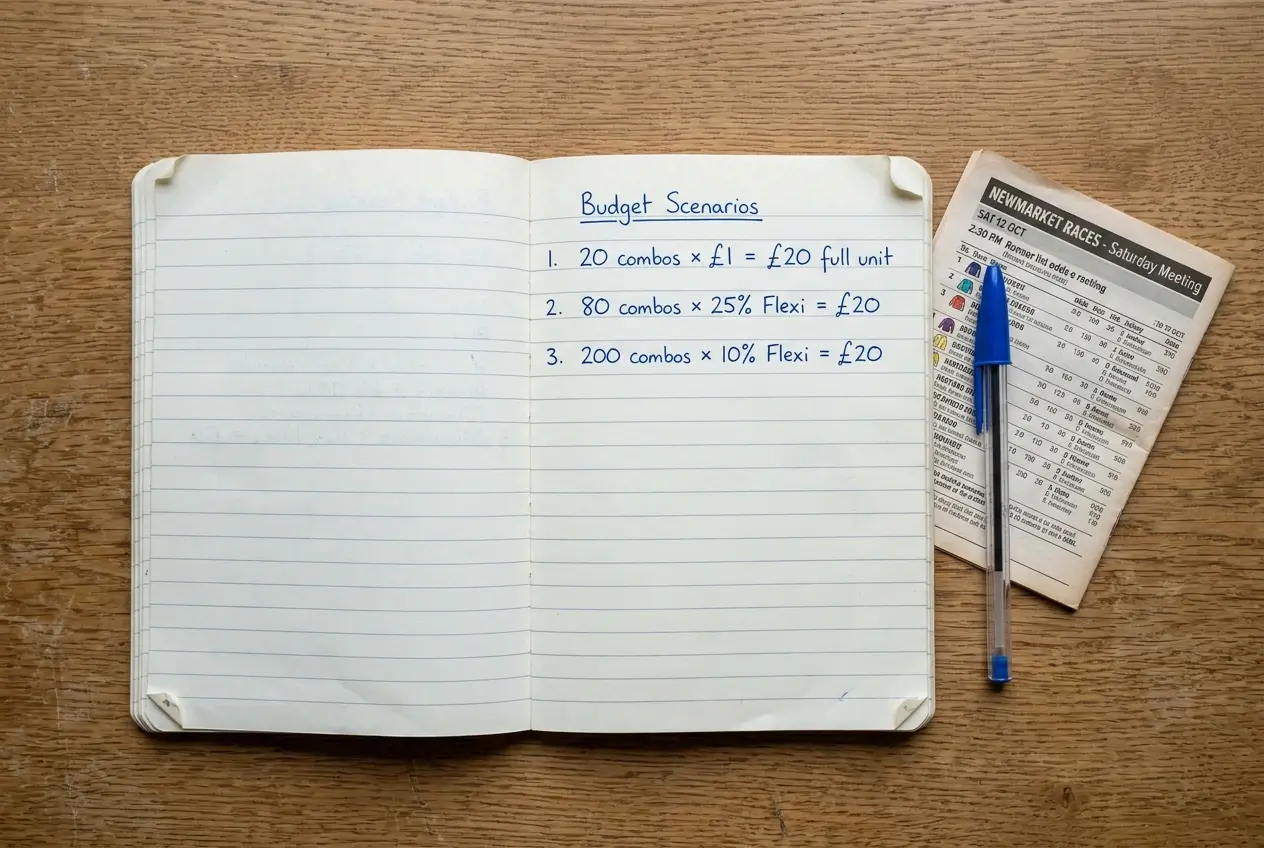
Set a maximum total spend for the quaddie before you look at the race card. Let’s say £20. That is your ceiling, and every decision you make about combinations must keep you at or below it.
From £20 you can afford:
- 100% Flexi on a 20-combination ticket (20 × £1 = £20)
- 25% Flexi on an 80-combination ticket (80 × £0.25 = £20)
- 10% Flexi on a 200-combination ticket (200 × £0.10 = £20)
None of these is inherently “better.” The question is which combination count gives you the best chance of covering the correct four winners, given your read on the card.
Where to allocate your width
A useful heuristic: identify your two strongest opinions across the four legs. Those are your narrow legs — one or two selections each. The remaining two legs, where you have less conviction, get wider coverage. This naturally keeps the combination count from spiralling.
An example: you are confident about the winner in legs 1 and 3, so you take single selections in both. Legs 2 and 4 look genuinely open — you want three runners in each.
1 × 3 × 1 × 3 = 9 combinations
Nine combinations at £1 per combination is a £9 full unit. At £20 budget, that gives you 222% Flexi — you can bet more than a full unit, which is unusual but entirely valid. Most punters in this situation would either add a second horse to the banked legs or increase the Flexi above 100% and simply accept a larger payout if they win.
Alternatively: you have no strong opinion in leg 4 at all — it is a wide-open five-runner race. You want all five:
1 × 3 × 1 × 5 = 15 combinations
Fifteen combinations at full unit means £15. With a £20 budget, you have £5 headroom — you could take a second horse in leg 2 for an extra 5 combinations:
1 × 4 × 1 × 5 = 20 combinations
Exactly £20 at full unit. That works out cleanly without needing Flexi at all.
When Flexi is the right choice versus narrowing selections
Flexi makes the most sense when you genuinely want the coverage but cannot afford the full unit. If your 108-combination ticket (4×3×3×3) costs £108 full unit and your budget is £30, the choice is:
- Drop one horse from leg 1 to return to a 3×3×3×3 (81 combinations, £81 full unit, still over budget) then Flexi at 37%:
£81 × 0.37 = ~£30 - Keep 4 selections in leg 1 and Flexi at 27.8%:
£108 × 0.278 = ~£30
The 81-combination ticket at 37% Flexi versus the 108-combination ticket at 27.8% Flexi — both cost £30. The difference is that the 81-combination version pays 37% of the dividend if it wins, while the 108-combination version pays only 27.8%. But the 108-combination version covers 27 additional paths. Neither is universally right; it depends on how confident you are that the fourth horse in leg 1 is a genuine contender. If you think it is a live chance, the extra coverage is worth the lower Flexi percentage. If you think it is an outsider you are covering out of anxiety rather than logic, drop it and take the higher Flexi.
Multiple tickets versus one wide ticket
Another approach: rather than one wide Flexi ticket, build two or three smaller, focused tickets. Each covers a different scenario — for example, one ticket with the market leader banked in leg 2, another with the second favourite. This is more complex to manage but can produce better coverage for the same total spend in certain race configurations. The total combination count across all tickets is not necessarily lower, but the per-ticket logic is cleaner and it is easier to assess what you actually need to win.
Whichever approach you use, always calculate the full unit cost before applying Flexi. Start with combinations, price the full unit, then decide how much of it your budget will buy.
A Worked End-to-End Example
Let me walk through a complete quaddie construction from budget to ticket — the same process I use when approaching a meeting.
The scenario
Budget: £25. Four nominated quaddie races at a UK Tote meeting. My read on the card:
- Leg 1 (Race 3): Two genuine contenders, no clear favourite. Selections: 2 horses.
- Leg 2 (Race 4): One standout — a well-backed market leader I am happy to bank. Selections: 1 horse.
- Leg 3 (Race 5): Wide-open handicap. Selections: 4 horses.
- Leg 4 (Race 6): Three runners look live. Selections: 3 horses.
Step 1 — Count the combinations
2 × 1 × 4 × 3 = 24 combinations
Step 2 — Calculate the full unit cost
24 combinations × £1 = £24.00 full unit cost
Step 3 — Determine the Flexi percentage
Budget is £25. Full unit is £24. I can bet at full unit (100%) and have £1 left over, or I can round up slightly to, say, 104% Flexi for exactly £24.96. In practice, 100% Flexi at £24 is the sensible choice here — I am within budget and receiving the full dividend on a winning combination.
Step 4 — What the dividend means in practice
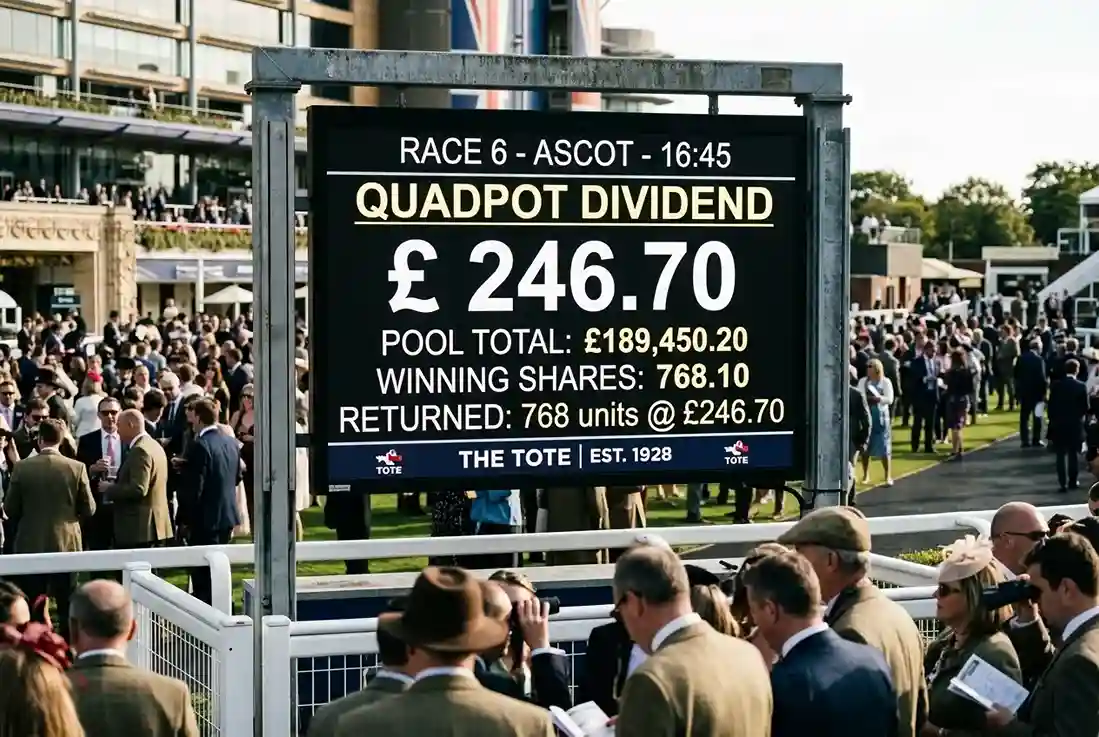
This is where the maths pays off. Say the four winners come in and the Tote Quadpot pool declares £840 to a £1 unit. At 100% Flexi on a £24 investment, I collect:
£840 × 1.00 = £840
Profit: £816 on a £24 stake.
Now suppose I had gone wider — say 3×2×4×3 = 72 combinations — but stayed at the £25 budget:
Flexi % = (£25 ÷ £72) × 100 = 34.7%
On the same £840 full-unit dividend:
£840 × 0.347 = £291.48
The extra coverage in leg 1 cost me over £500 in hypothetical payout. Whether that trade-off was worth it depends entirely on whether the third horse in leg 1 was a real chance — pure form judgement, not maths.
The scale of what pool dividends can reach
To understand what full-unit coverage of a winning ticket can look like at the extreme end: the Melbourne Cup quaddie in 2024 declared A$512,000 to a full unit. That ticket was built on four winners — Knight’s Choice at A$63, Catoggio at A$35, Fancify at A$6.30, and Bel Air at A$12.40. The same meeting’s First 4 paid A$728,000, and one punter reportedly turned a A$100 ticket into A$3.2 million via a Ladbrokes exotics bet on the same race. These figures are outliers — Cup day pools are uniquely large, the fields are stacked with international runners, and four winners at those prices is an extremely rare alignment. But they illustrate why the maths of combination counting and Flexi management matters: a modestly sized ticket, constructed carefully, can carry a meaningful percentage of a vast pari-mutuel dividend when everything lands right.
For most UK meetings, quaddie-equivalent (Quadpot) dividends are measured in hundreds or low thousands of pounds per unit. The Royal Ascot Placepot hit £26,424 in 2025 at the top end of a festival pool. Even at those more realistic figures, a 10% Flexi share on a £81 full-unit ticket (cost: £8.10) returns over £2,600 on a winner. The arithmetic is compelling when you understand it.
Checklist before placing
Before I confirm any quaddie or Quadpot ticket, I run through three checks: combination count correct? (multiply it out manually), full unit cost within budget range? (or Flexi percentage calculated?), and does each leg contain only runners I genuinely want? If any leg has a horse included purely out of nervousness rather than form reasoning, I cut it. Wider is not always better — it just costs more. Stretching the same budget further: flexi betting.
Frequently Asked Questions
What does ‘3x3x3x3’ mean on a quaddie ticket?
It means you have selected three runners in each of the four legs. Multiply them together: 3 × 3 × 3 × 3 = 81 combinations. That is the number of unique four-horse paths your ticket covers, and the number you multiply by your per-combination stake to get the full unit cost.
What is the smallest Flexi percentage I can take?
It depends on the operator’s minimum total stake. At the UK Tote, the minimum total investment is £2. Divide £2 by your full unit cost to find the lowest Flexi percentage that meets this floor. For a £81 full-unit ticket, that is roughly 2.5%. In practice, most punters aim for at least 10% to keep a meaningful share of any dividend.
Why does the same quaddie cost different amounts at different bookmakers?
The unit stake differs between operators. Australian TAB pools typically use a A$1 base unit; some UK products use £1 per combination, others may vary. The Flexi mechanism also differs in how it is labelled and applied. Always check the specific platform’s pricing before confirming your ticket, particularly when crossing between UK and Australian products.
How do I convert a Flexi percentage back into a cash payout?
Multiply the declared full-unit dividend by your Flexi percentage expressed as a decimal. If the pool declares £600 to a £1 unit and you bet at 20% Flexi, your payout is £600 × 0.20 = £120. On a multi-combination ticket, this applies per winning combination — so if you covered three winning paths, each one pays £120, giving a total return of £360.
This material was created by the FourCast team.
Related posts

Quaddie Tips: How to Read, Judge and Use Daily Selections
Pool Betting vs Fixed Odds: Where the Value Evidence Points