
Scoop6 Betting Explained: The Saturday Six-Race Pool and Its Funds
 Available in US
The bet that divides British racing into people who’ve won it and people who’ve tried
The Scoop6 occupies a peculiar place in British pool betting. It runs every Saturday on six designated televised races, it has produced some of the largest single-day payouts in UK betting history, and yet the majority of people who enter it each week will tell you they’ve never even come close. I’ve been in that majority more times than I care to admit. What makes it compelling despite the difficulty is the three-fund structure — you’re not just competing for one prize, you’re buying into a system where even a partial result generates a payable outcome, and where a bonus fund can turn an already substantial win into something genuinely extraordinary. The full picture is in our complete guide to quaddie betting.
The Scoop6 requires you to select the winner of six designated Saturday televised races. Pick all six correctly and you win a share of the Win Fund — the main jackpot pool. Fail to get all six but pick five, and you win a share of the Place Fund. The Bonus Fund is separate: the previous week’s Win Fund winner can return the following Saturday, pick one nominated horse, and if it wins, they collect the accumulated Bonus Fund on top of their original win. The three-fund architecture is what distinguishes the Scoop6 from every other pool product in the British market.

The six legs and the fund structure
The six races are designated each week by the Tote from the Saturday afternoon televised schedule — typically the major ITV races from the weekend’s programme. The leg selection changes weekly based on what’s racing, which means the difficulty of the card varies substantially from one Saturday to the next. A card dominated by competitive open handicaps is considerably harder to crack than a card with three or four conditions races where a single short-priced horse dominates the market.
Each fund operates independently. The Win Fund collects a portion of the weekly turnover and carries over if unclaimed — exactly like the Tote Jackpot mechanic. The Place Fund also carries over when not fully claimed: if nobody picks five-from-six, the Place Fund rolls to the following Saturday. The Bonus Fund is different: it accumulates from a portion of each week’s Win Fund, grows independently, and can only be claimed by the current Win Fund winner on the following Saturday. If the Bonus Fund winner’s chosen horse doesn’t win, the Bonus Fund continues to accumulate.

The result is a product that can generate extraordinary prize levels over time. A Scoop6 Win Fund that has rolled over for several weeks, combined with a Bonus Fund that has been accumulating for months, can represent a genuinely life-altering sum — well into six figures, occasionally reaching seven. Those moments attract enormous media coverage and drive a surge of new entrants, which further inflates the pools.
Place Fund, Win Fund, Bonus — what each one pays
Understanding which fund pays what and when determines whether you should enter at all on a given Saturday. The Win Fund is the main event: all six correct selections, split among all winning tickets. Standard pool mechanics apply — more winning tickets means a smaller per-unit return, fewer winning tickets means a larger one. A difficult Saturday card that produces several unexpected winners will distribute the Win Fund among very few tickets, which is when the per-ticket return reaches its maximum.

The Place Fund pays out to tickets with five correct selections when no ticket achieves six. This creates a meaningful secondary tier — on a card where the sixth race produces a genuine shock winner, the five-from-six consolation can still be a substantial dividend if the pool has been accumulating. On easy cards where short-priced favourites win most races, many tickets will survive to five legs, and the Place Fund dividend per ticket shrinks accordingly.
The Bonus Fund mechanism is the most distinctive element of the Scoop6. After winning the Win Fund, the winner is invited back the following Saturday to pick a single horse in a nominated race. If that horse wins, they receive the entire accumulated Bonus Fund. If it loses, they keep their Win Fund return and the Bonus Fund continues to grow. This creates a genuine “double or nothing” moment — the previous winner’s horse is typically well-publicised, which generates excitement and additional ticket sales in the following week’s pool.

Scoop6 versus other pool products
The Scoop6 occupies a different market position to the Tote Placepot and the Jackpot. The Placepot runs every day at every meeting — it’s a regular, accessible product with modest entry costs and achievable difficulty. The Jackpot is harder and carries over when unclaimed, but it runs across a full card at a designated meeting rather than being specifically Saturday-televised-races-only. The Scoop6 sits at the top of the difficulty curve: six winners required from a specific set of Saturday races, no consolation tier below five, and three separate funds that can accumulate to enormous values independently.

The Saturday timing is not incidental. It concentrates betting turnover — and therefore pool size — onto one day, with the six best-televised races providing a shared framework for punters who might not be familiar with the full card at every venue. A casual punter who only watches ITV Racing on Saturday afternoons can follow the Scoop6 narrative without needing deep knowledge of mid-week provincial meetings. That accessibility is what drives the Scoop6’s profile even though the bet itself is among the most difficult in British racing.
For a closer look at how the Jackpot’s carry-over mechanic works alongside the Scoop6’s approach to rolling funds, the Tote Jackpot guide covers the carry-over and must-be-won structure in detail.
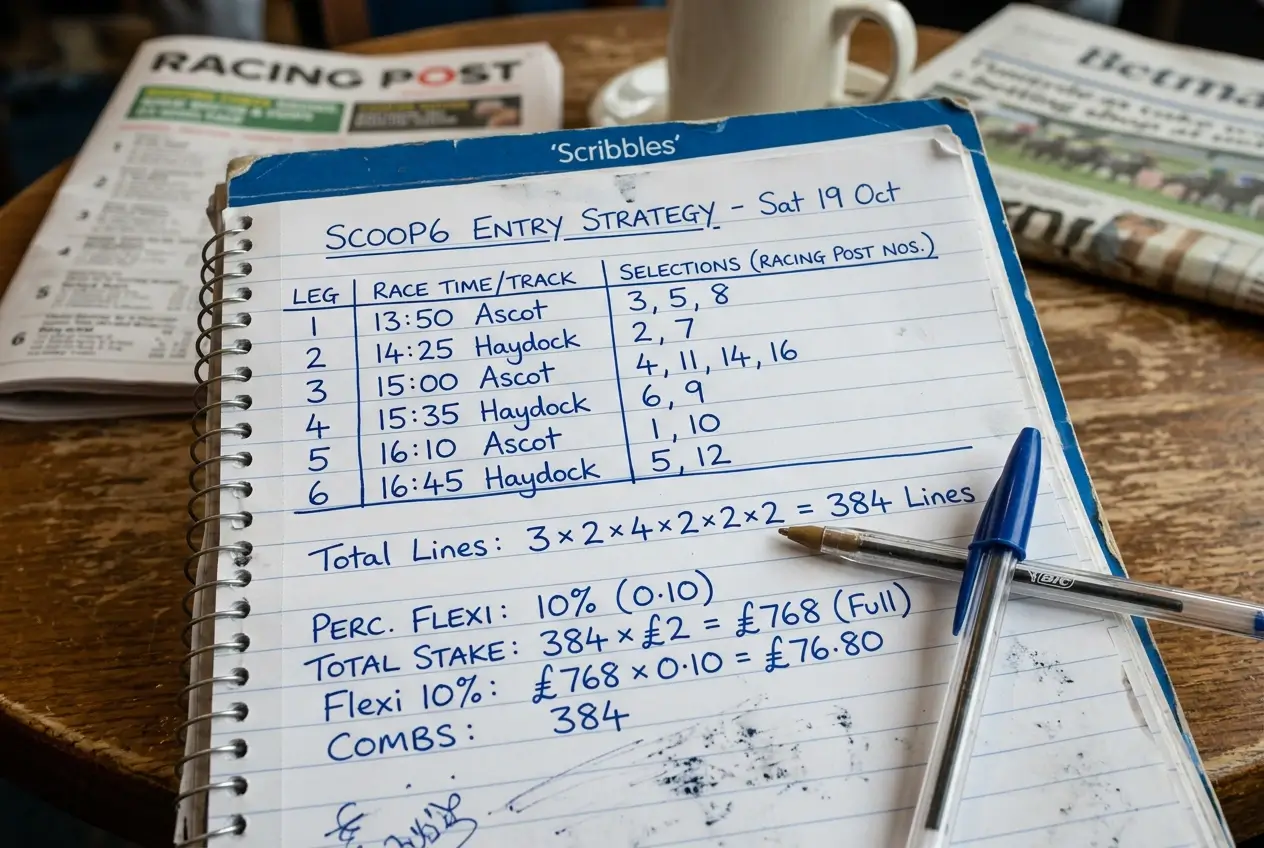
Entry strategy for the Scoop6 is a subject that serious pool punters approach differently to casual entrants. Because six winners are required, even a modestly spread structure — two selections in each leg — generates 2x2x2x2x2x2 = 64 combinations, which at the minimum unit stake represents a substantial outlay. Most experienced Scoop6 punters use flexi betting to maintain broad coverage while keeping the cost proportionate to the pool size. On a week where the Win Fund is modest and shows no sign of being exceptional, a small flexi stake on a tightly structured ticket is rational. On a week where the Win Fund has been rolling for four Saturdays and sits at a significant accumulated value, the case for wider coverage and a larger flexi percentage is considerably stronger. The weekly nature of the product also means you get a fresh decision point every Saturday — there is no compulsion to enter at all if the week’s card looks either too easy (low dividend potential) or too difficult to justify the coverage cost. The other multi-race pool: the Tote Jackpot.
What races make up the Scoop6?
Six designated Saturday televised races, chosen each week by the Tote from the ITV Racing schedule. The specific races change every Saturday depending on the racing programme. The selection is announced in advance so punters know which races they’re betting across.
What is the Scoop6 Bonus Fund?
The Bonus Fund is a separate pool that accumulates from a portion of each week’s Win Fund. After winning the Win Fund, the winner returns the following Saturday to select one horse in a nominated race. If that horse wins, they collect the entire Bonus Fund. If it loses, the Bonus Fund continues to accumulate and the opportunity passes to the next Win Fund winner.
How is the Scoop6 different from the Jackpot?
The Scoop6 runs on six designated Saturday televised races specifically, while the Jackpot runs on nominated races at a designated meeting on any day of the week. The Scoop6 has three separate funds (Win, Place, Bonus) with its own carry-over and bonus mechanics. The Jackpot has a simpler single-pool structure that carries over when unclaimed.
This material was created by the FourCast team.
Related posts

Quaddie Tips: How to Read, Judge and Use Daily Selections
Pool Betting vs Fixed Odds: Where the Value Evidence Points