
Biggest Quaddie Payouts: Record Dividends and the Races That Produced Them
 Available in US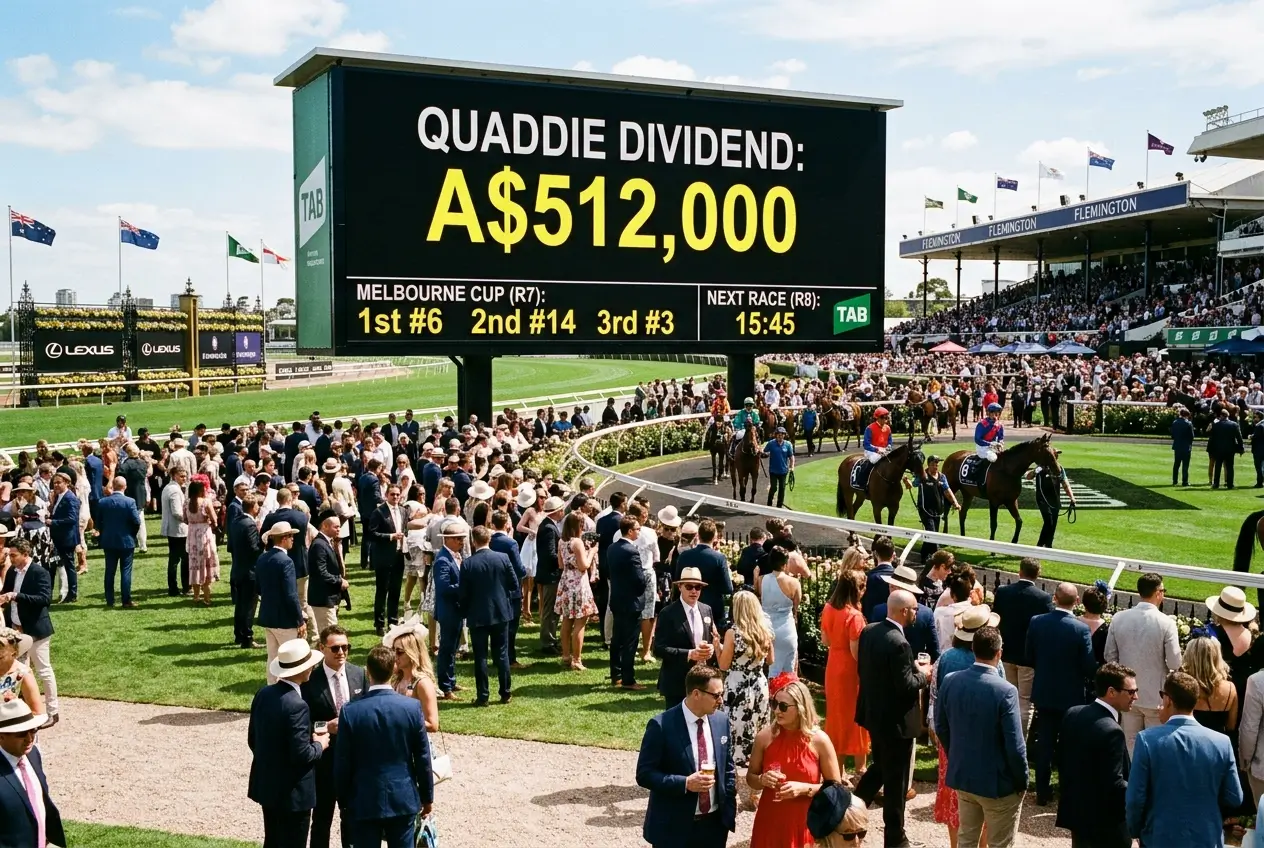
The dividends that remind punters what pool betting is actually for
There’s a category of pool betting result that exists purely to remind you what the product can do when conditions align. Not the reliable, modest dividends that justify systematic participation week after week, but the extreme cases — the cards where form goes sideways, where three or four consecutive surprises eliminate the vast majority of the pool’s tickets, and the surviving fraction collects a figure that most people would dismiss as implausible if they heard it without context. The biggest quaddie payouts are those cases. Understanding what produced them is more instructive than simply admiring the numbers. The full picture is in our complete guide to quaddie betting.
The Australian quadrella — the four-leg winner-selection pool that the word “quaddie” describes — has been running in various forms since the 1970s and has produced some extraordinary dividends over that time. The Melbourne Cup day card, with its uniquely concentrated national attention, large pool turnover, and historically competitive field, accounts for several of the most prominent records. Other major metropolitan Saturdays — Flemington, Randwick, Caulfield, Rosehill — have contributed their own landmark results on days when form produced a sequence of unexpected winners across the designated four legs.
Melbourne Cup day 2024: A$512,000
The 2024 Melbourne Cup quaddie is the most recently documented record at the top end of Australian quaddie dividends. The four winning horses were Knight’s Choice at $63, Catoggio at $35, Fancify at $6.30, and Bel Air at $12.40. Three of the four winners were at substantial prices — only Fancify, at $6.30, was the kind of price that most quaddie tickets would routinely include. Knight’s Choice at $63 and Catoggio at $35 were not the horses most ticket-holders were counting on.
The arithmetic behind the A$512,000 dividend is transparent. A large Cup day pool — Australian thoroughbred racing turnover runs to approximately A$29 billion per financial year, with Cup day attracting a disproportionate share of that annual figure — divided among an exceptionally small number of winning tickets produced the extraordinary per-unit return. The winning units would have been in single figures: perhaps three or four tickets across the entire commingled pool held all four winners. Divide a pool of several million dollars by four winning units and you reach a figure in the hundreds of thousands per unit. The mathematics isn’t remarkable; it’s the combination of results that made the number of winning tickets so small.
The same card also produced a First 4 dividend of A$728,000 — the first-four-finishers-in-order pool. That figure exceeded the quaddie on the same day, reflecting the additional difficulty of the First 4’s order-of-finish requirement. Both dividends were genuine products of a difficult card at the world’s most publicly prominent horse race, on a day when Australian pool betting turnover was at or near its annual peak.
What makes a record dividend
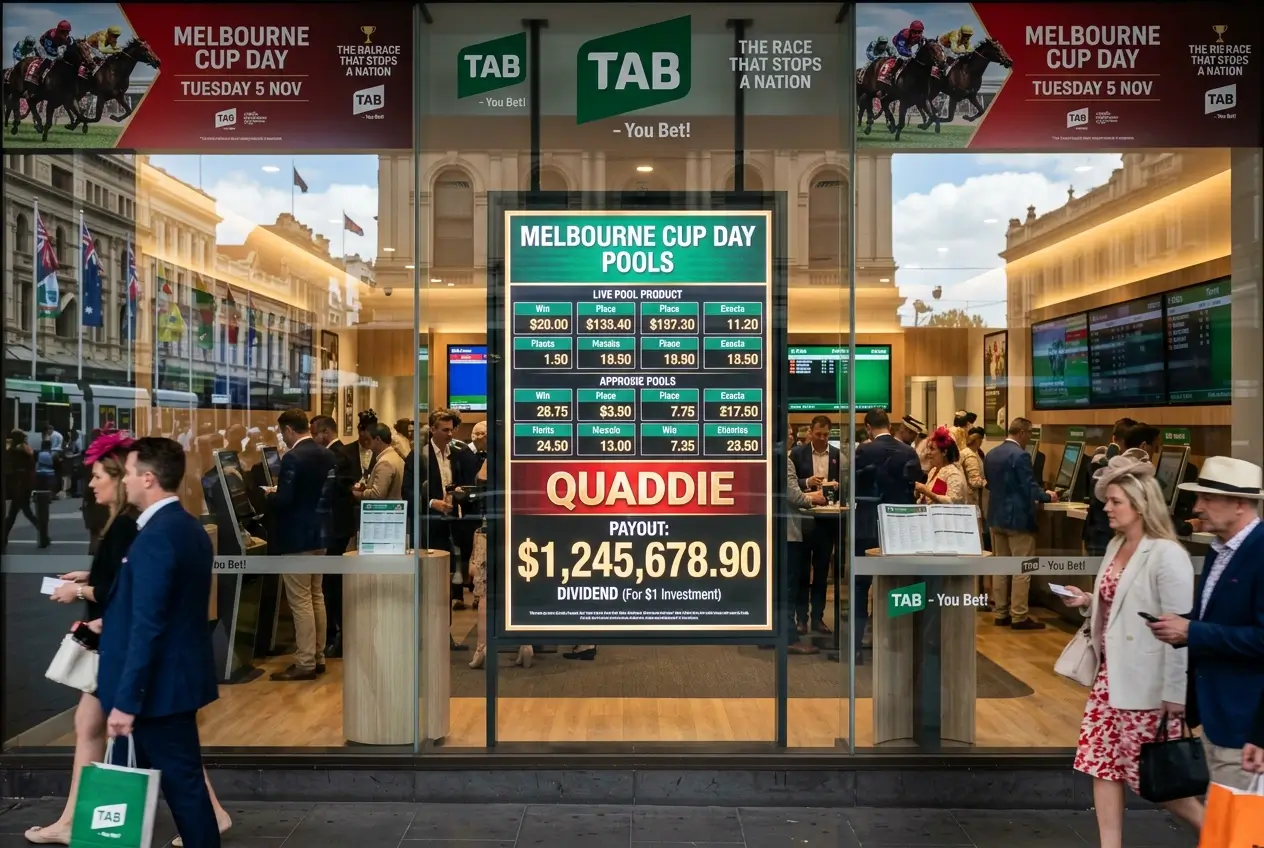
The recipe for a record quaddie dividend has never changed: a large pool, and very few winning tickets. The variables that produce very few winning tickets are the results themselves — specifically, results that diverge from consensus betting. When all four quaddie legs produce heavily-backed market leaders, many tickets survive, the dividend is modest, and the record books go unthreatened. When three or four legs produce substantial-priced winners, the ticket population that correctly called all four is tiny, and the per-unit dividend scales accordingly.
The specific mechanism is exponential rather than additive. A roughy in leg 1 might eliminate 70% of tickets — leaving 30% of the original ticket population live entering leg 2. A roughy in leg 2 might eliminate 70% of the survivors — leaving 9% of the original pool. A roughy in leg 3 eliminates 70% again — 2.7% remaining. By leg 4, even a well-backed result finds a ticket pool that has been compressed to a tiny fraction of its original size. The per-unit dividend doesn’t double or triple with each roughy result — it multiplies. That compounding elimination across four legs is what produces dividends an order of magnitude beyond what any single rough winner would generate on its own.

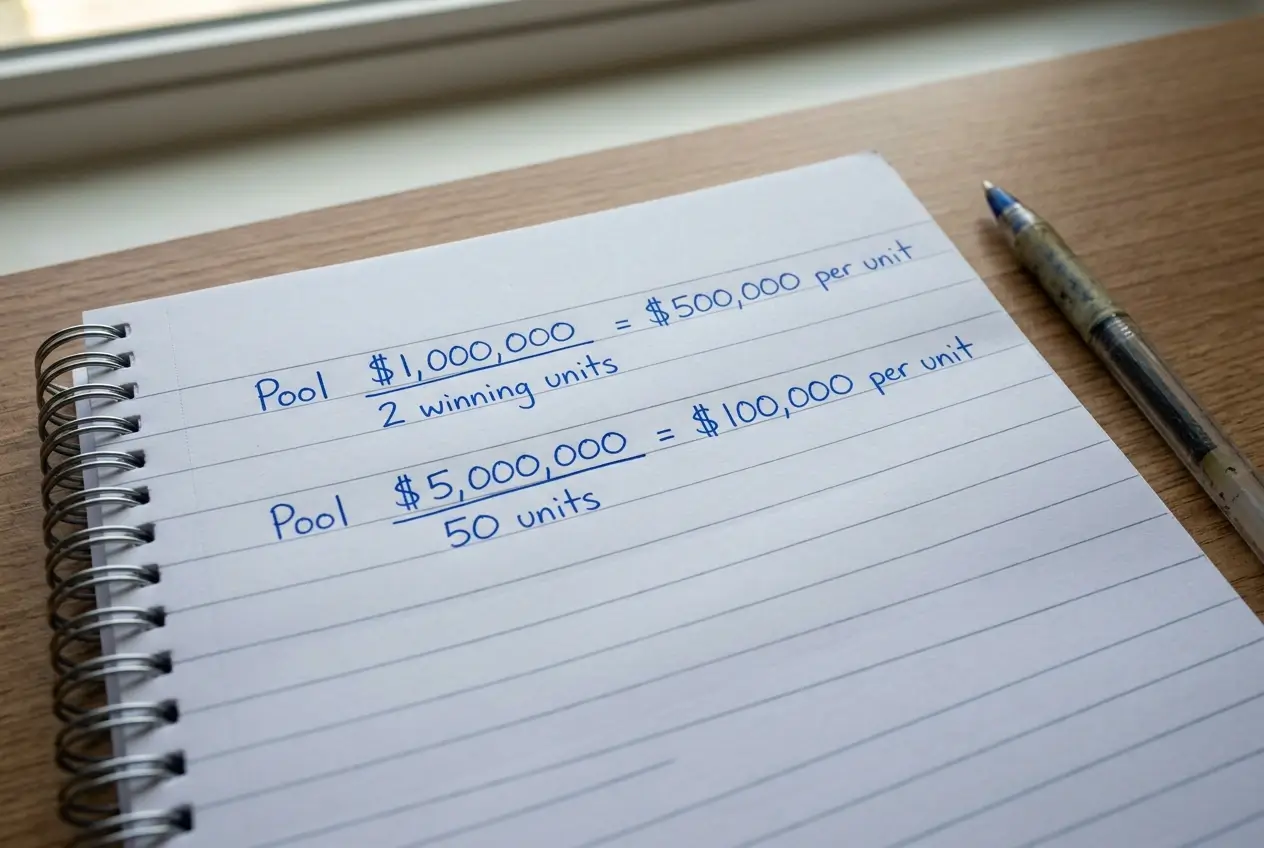
This structural explanation also tells you what conditions to look for when hunting a potentially large quaddie. Four legs, each with genuine uncertainty, on a card where the market has priced the dominant horses at odds that don’t allow for credible alternatives. On those cards — typically mid-tier metropolitan Saturday races rather than flagship Group 1 meetings where the form is more established — the conditions for a large dividend are present even if the pool is smaller than Cup day. A A$1 million pool where only two tickets survive pays A$500,000 per unit. A A$5 million pool where 50 tickets survive pays A$100,000 per unit. Pool size matters, but ticket concentration matters more.
Record context for UK punters
Australian quaddie dividends are denominated in Australian dollars and reflect pool sizes that dwarf most UK pool products on ordinary race days. The scale comparison requires a calibration: Australian thoroughbred racing turnover of approximately A$29 billion annually supports pool products that are simply larger than their UK equivalents in absolute terms. A Cup day quaddie pool in Australia has no direct UK Placepot equivalent in magnitude, though the Cheltenham Festival Placepot — with its £1,000,000 guaranteed pool per day — approaches the spirit of the comparison on the four days per year when the conditions are most aligned.
The record Cheltenham Festival Placepot of £182,568 to a £2 stake in 2019 is the UK equivalent data point. The mechanism that produced it is identical to the Melbourne Cup quaddie: large pool, difficult card, very few surviving tickets, extreme per-unit return. The Tote Placepot differs structurally from the quaddie in that it asks for placed runners rather than winners, and covers six legs rather than four — but the pari-mutuel arithmetic is the same. Both records were produced by the same dynamic: a pool too large to be reduced to small absolute values, distributed among too few tickets to dilute the per-unit return below a spectacular number.

For punters who want to understand the underlying arithmetic that produces all of these outcomes — and apply it to their own betting rather than just reading about headline records — the biggest quaddie payout guide provides the framework for identifying when large dividend conditions are in prospect, not just cataloguing when they’ve already occurred. How the dividend is worked out: the calculation.
What is the biggest quaddie payout in history?
The 2024 Melbourne Cup quaddie paid A$512,000 per winning unit, making it one of the largest documented Australian quaddie dividends. The four winners were Knight’s Choice ($63), Catoggio ($35), Fancify ($6.30), and Bel Air ($12.40). Three of the four were at substantial prices, leaving very few tickets in the pool holding all four correct winners and concentrating the large Cup day pool among a tiny number of surviving tickets.
Why do some quaddies pay so much more than others?
Because the dividend is determined by dividing the net pool among the winning units — and when form produces several unexpected results, very few tickets hold all four winners. Each roughy winner in sequence eliminates a large proportion of the surviving ticket population through a compounding effect. By the time four consecutive surprise results have been run, the remaining winning tickets may be a single-figure count, producing a per-unit return that multiplies with each successive elimination.
Can UK pool products pay dividends as big as Australian quaddies?
In absolute terms, UK pool products have produced exceptional dividends: the record Cheltenham Festival Placepot is £182,568 to a £2 stake (2019). The mechanism is identical — large pool, concentrated among few surviving tickets. Australian quaddies can reach higher absolute figures because Australian racing turnover is substantially larger, but the structural dynamics that produce extreme dividends are the same in both jurisdictions.
This material was created by the FourCast team.
Related posts

Quaddie Tips: How to Read, Judge and Use Daily Selections
Pool Betting vs Fixed Odds: Where the Value Evidence Points