
Biggest Placepot Payouts: Record UK Dividends and What Produced Them
 Available in US
The number that stops conversations about pool betting
There is one number that, when it comes up in any discussion about British pool betting, tends to silence the sceptics: £182,568. That’s the record Cheltenham Festival Placepot dividend, declared to a £2 stake in 2019. Per £1 unit, the return was £91,274.50. It was paid to every winning ticket in the pool. The fact that very few tickets survived the day’s racing to collect it is, of course, exactly why it reached that figure — and understanding the mechanism that produces these records is more instructive than just admiring the numbers. The full picture is in our complete guide to quaddie betting.
The Tote Placepot has been running since the Tote’s establishment in 1928, making it one of the oldest continuously operating pool products in British racing. In nearly a century of operation, the records it has set are the product of recurring conditions: a large pool, a difficult card, and a concentration of results that systematically eliminating the majority of tickets. When all three factors align — as they did at Cheltenham in 2019 — the dividend becomes extraordinary. Understanding those conditions helps you recognise when a big dividend might be in prospect, not just marvel at the ones that have already happened.

The Cheltenham 2019 record
The 2019 Cheltenham Festival produced the largest Placepot dividend in the history of British pool betting. The card that day combined the deep competitive fields typical of the Festival with a series of results that fell outside the consensus. By the time the sixth race had been run, the pool — already substantial because of the Festival’s £1,000,000 guarantee — had been concentrated into an exceptionally small number of surviving tickets. The declared dividend of £182,568 to a £2 line reflected a pool distributed among a tiny handful of correct sequences across six competitive races.
What made the 2019 card particularly unforgiving was the combination of results across the first six legs. Several runners that the majority of Placepot tickets were counting on for survival either failed to place or were beaten by horses at sufficiently long prices that few tickets had included them. Each such result eliminated a large tranche of the pool’s tickets, and the compounding elimination across six legs left the net pool — already well above the guaranteed million — to be shared among very few survivors. The record wasn’t set by luck; it was the predictable arithmetic outcome of a large pool meeting a very hard card.
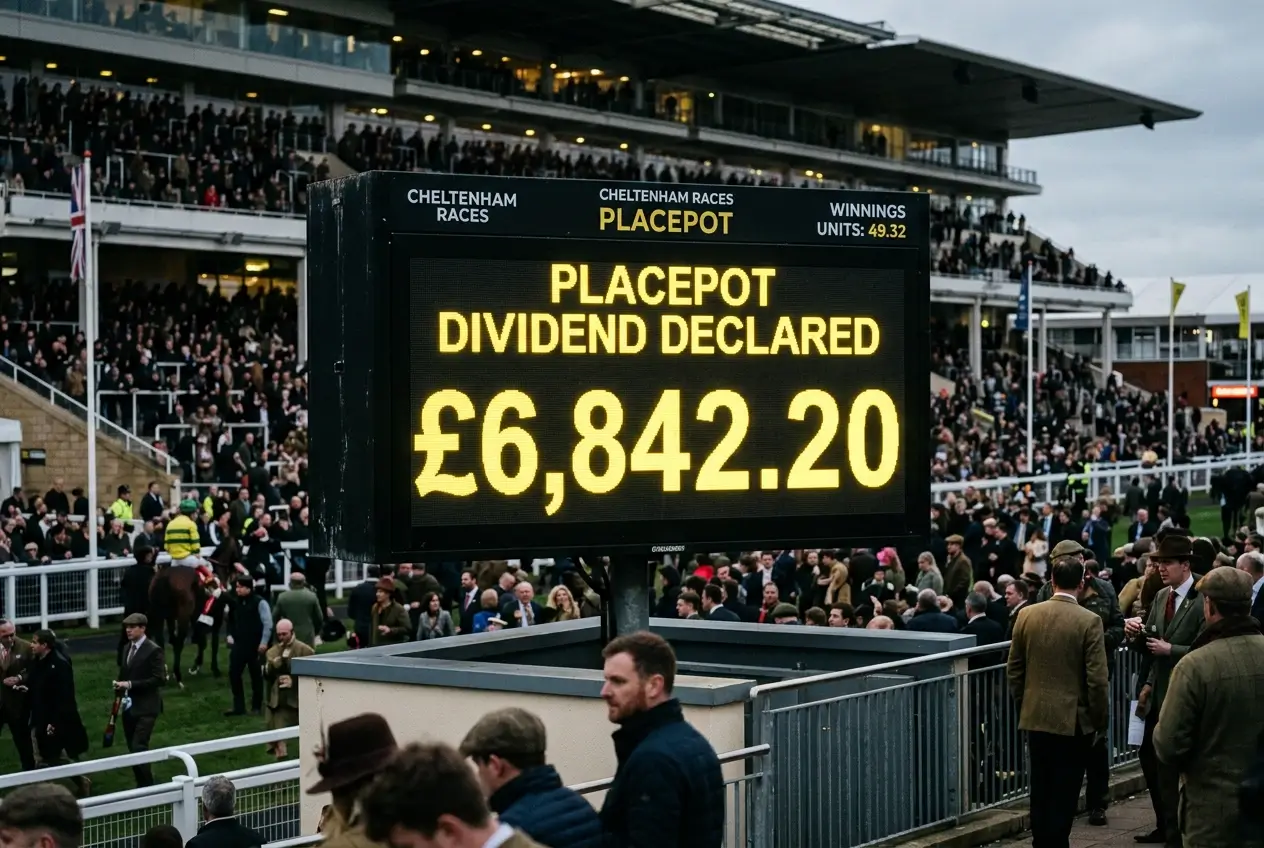
The five-year average Cheltenham Festival Placepot dividend exceeds £2,361. On a day where the record was set at £182,568, the “average” Festival day still delivers a return that is more than five times the typical daily UK Placepot average of approximately £466. The Festival consistently produces the highest average Placepot dividends in the British racing calendar, and 2019 was an extreme expression of the structural dynamics that apply every year.
Royal Ascot 2025: the year’s biggest
The largest UK Placepot dividend of 2025 was £26,424.30, declared at Royal Ascot. The dividend was shared across approximately 18.15 winning units — a figure that illustrates how concentrated the pool had become by the end of the six-leg sequence. That works out to roughly £1,456 per full unit, which remains a substantial return on a £2 minimum investment.

The Royal Ascot dividend puts the Cheltenham record into perspective as an extreme outlier, while also confirming that major festival meetings regularly produce dividends that dwarf ordinary race days. In 2025, no other meeting came close to the Royal Ascot figure — the combination of the meeting’s competitive five-day card, strong pool turnover, and the difficulty of landing a placed runner in six consecutive high-quality races created the conditions for an exceptional return.
What both the Cheltenham 2019 record and the Royal Ascot 2025 result share is a common structure: a large pool, concentrated into a small number of surviving tickets by a difficult card. The pool’s unlimited upside — the structural feature that no fixed-odds product can replicate — means that when a festival card produces several unexpected placed runners, the dividend potential is bounded only by the pool size and the number of surviving tickets. A sufficiently difficult card at Cheltenham could, in principle, produce a dividend that exceeded even the 2019 record if the pool is large enough and the results sufficiently unexpected.

What produces record dividends
The recipe for a record Placepot dividend has three consistent ingredients. First, a large pool — either from strong natural turnover at a major meeting or from the Tote’s guaranteed minimum providing a floor. Second, a difficult card — races where the “obvious” placed runners fail to oblige, eliminating large numbers of tickets that backed the consensus choices. Third, a concentration of results in the later legs — a difficult sixth race that eliminates most of the tickets that survived the first five legs is more valuable to the dividend than a difficult first race, because fewer total tickets survive to the sixth leg in any case.
The timing of difficult results matters. A result that eliminates 80% of remaining tickets in leg 3 is more impactful than the same result in leg 1 — because by leg 3, the pool has already been through two elimination rounds, and the remaining 20% of a depleted ticket pool represents a larger proportion of a smaller number. Each successive elimination round multiplies the effect of the previous one, which is why Placepot dividends on difficult cards tend to be disproportionately large rather than just proportionally large.

For punters looking to target big dividends rather than simply hoping to encounter them, the implication is that the highest-value Placepot opportunities are Festival cards where the guaranteed pool is large and the card is expected to be genuinely difficult — Cheltenham in March, Royal Ascot in June, the Champions meeting at Ascot in October. These are the meetings where all three dividend ingredients are most likely to align. The standard daily Placepot guarantee of £50,000 provides the floor on ordinary days, but it’s the £1,000,000 Festival guarantee that sets the conditions for truly exceptional returns. For the structural mechanics of how the Placepot pool calculates its dividend, the Tote Placepot guide covers the full product in detail. How the bet itself works: the Tote Placepot.
What is the biggest Placepot dividend ever paid?
The record UK Placepot dividend is £182,568 declared to a £2 stake at the 2019 Cheltenham Festival. Per £1 unit, that represents a return of £91,274.50. It was produced by a combination of a large guaranteed pool — £1,000,000 minimum per Festival day — and a particularly difficult card that eliminated almost every ticket before the sixth race.
What was the largest Placepot dividend of 2025?
The largest UK Placepot dividend of 2025 was £26,424.30, declared at Royal Ascot. It was shared across approximately 18.15 winning units, reflecting how few tickets survived the competitive five-day Royal Ascot card. This was the highest Placepot return at any UK meeting during 2025.
How often does the Cheltenham Festival produce big dividends?
Consistently. The five-year average Cheltenham Festival Placepot dividend exceeds £2,361, compared to a UK daily average of around £466. The Festival’s large guaranteed pools — £1,000,000 minimum per day — combined with its uniquely competitive card make it the most reliable source of high Placepot dividends in the British racing calendar. Most Festival days produce dividends well above the UK average even without a record-setting card.
This material was created by the FourCast team.
Related posts

Quaddie Tips: How to Read, Judge and Use Daily Selections
Pool Betting vs Fixed Odds: Where the Value Evidence Points